Germany
 Austria
 Belarus
 Belgium
 Bosnia and Herzegovina
 Bulgaria
 Croatia
 Czech Republik
 Denmark
 Finland
 France
 Georgia
 Great Britain
 Hungary
 Ireland
 Latvia
 Lithuania
 Netherlands
 Poland
 Portugal
 Romania
 Serbia
 Slovakia
 Spain
Spain
 Sweden
 Switzerland
 Ukraine
 Ethiopia
 Ghana
Ghana
 Egypt
Egypt
 Guinea
 Israel
 India
India
 Kazakhstan
 Malaysia
 Singapore
 United Arab Emirates
 Vietnam
 Taiwan
 Philippines
 New Zealand
 Australia
 Canada
 Brazil
 Paraguay
 Uruguay
 Bolivia
 Chile
Chile
 Peru
Peru


How can density variations and compaction defects in concrete products be avoided?
How can density variations and compaction defects in concrete products be avoided?
In the production of directly demoulded concrete goods, quality is decided in seconds. From discharge into the mould to final compaction, everything has to go right: fast, even mould filling, consistent density across the board, and enough green stability to survive immediate demoulding without deformation. Filling aid admixtures are designed specifically for this critical window.
How do filling aids work?
Their core job is to improve how stiff concrete behaves during mould charging and compaction. Semi-dry concrete is always a balancing act: it needs enough cohesion to hold its shape, but not so much internal friction or stickiness that it resists flowing into edges, corners and fine mould details. Filling aids shift this balance in the right direction, through better wetting and distribution of fine particles, reduced adhesion to machine surfaces, and more even movement of the mix under vibration and pressing. The result is more consistent behaviour during production, without losing the green stability needed for immediate demoulding.
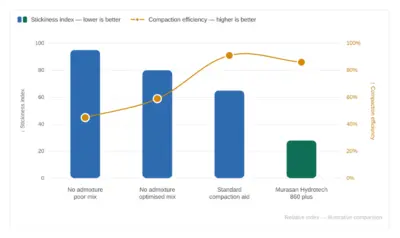
Stickiness & compaction across concrete mix scenarios
Mix design optimisation and standard compaction aids can both reduce stickiness and improve mould filling. A dedicated filling aid goes further, achieving the best stickiness reduction while also supporting compaction at a level close to a standard compaction aid.
Production benefits from filling aids
In practice, this means fewer typical production problems: underfilled edges, density differences across the production board, visible compaction pores and uneven surface texture. Lower porosity and more uniform compaction improve strength, reduce water uptake and support long-term durability. More stable production also means fewer rejects and less waste, so filling aids matter for process efficiency just as much as product quality.
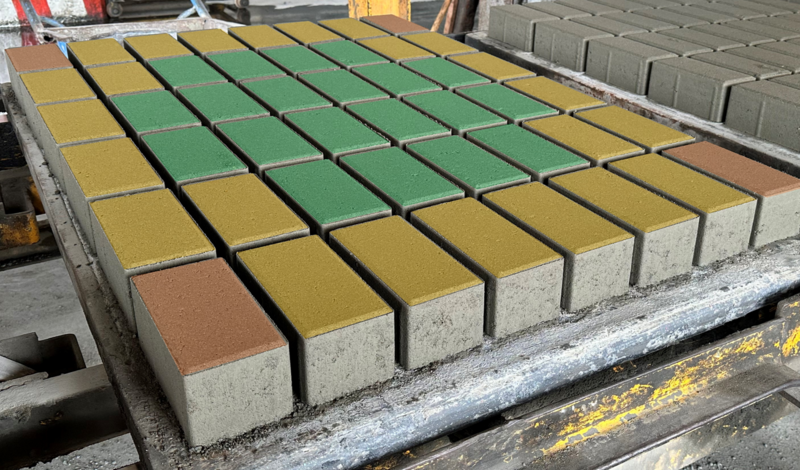 Without filling aid: Density varies significantly across the board. Edge and corner stones show reduced compaction, while only the centre stones reach the target density.
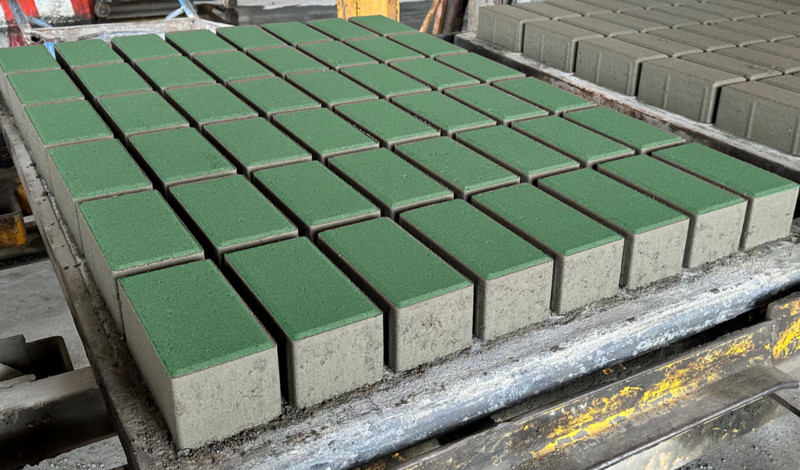 With Murasan Hydrotech 860 plus: Consistent density across the entire production board. Even fill and compaction from centre to edge.
Influencing factors
- moisture content and its even distribution across each batch
- aggregate grading and fines content, which control particle packing and internal friction
- cement type and binder fineness, which affect how the admixture interacts with the paste
- temperature and plant conditions, which influence stiffening rate and working time
- machine settings, vibration energy and pressing force, which determine how well the admixture's potential converts into real compaction
Application and products
Key benefits include:
- consistent density across the production board
- reduced waste and rejects
- better compaction
- smoother surfaces
- higher and more reliable mechanical properties, all in a chloride- and alkali-free formula