 Germany
 Austria
 Belarus
 Belgium
 Bosnia and Herzegovina
 Bulgaria
 Croatia
 Czech Republik
 Denmark
 Finland
 France
 Georgia
 Great Britain
 Hungary
 Ireland
 Latvia
 Lithuania
 Netherlands
 Poland
 Portugal
 Romania
 Serbia
 Slovakia
 Spain
Spain
 Sweden
 Switzerland
 Ukraine
 Ethiopia
 Ghana
Ghana
 Egypt
Egypt
 Guinea
 Israel
 India
India
 Kazakhstan
 Malaysia
 Singapore
 United Arab Emirates
 Vietnam
 Taiwan
 Philippines
 New Zealand
 Australia
 Canada
 Brazil
 Paraguay
 Uruguay
 Bolivia
 Chile
Chile
 Peru
Peru


Grout Concrete and Mortar: DAfStb Insights
Grout Concrete and Mortar: DAfStb Insights
DAfStb stands for “Deutsche Ausschuss für Stahlbeton” which means “German Committee for Reinforced Concrete”. The DAfStb has been established 1907 and is an internationally recognised and respected body that promotes concrete construction. The DAfStb guideline for the “Manufacture and use of cement-based grout concrete and grout mortar” was published in July 2019.
It serves as a technical set of rules for the production, processing and application of these special building materials, which are characterised by high flowability, early strength and volume stability. The guideline supplements existing standards such as DIN EN 206-1 and DIN 1045-2 with specific requirements for grouting concretes and mortars.
Distinctive features
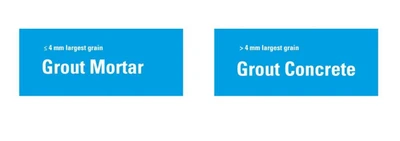
After mixing, i.e., in their fresh state, grout products exhibit excellent flow properties, and once hardened, they achieve outstanding compressive strengths. In this regard, grout concretes and grout mortars differ significantly from conventional concrete, as they are particularly flowable, have a high fines content, and exhibit expansive behaviour. The DAfStb guideline restricts the composition of grout concretes and mortars to four components: cement, mineral aggregates, concrete admixtures, and, if necessary, concrete additives.
Compressive strength
With this composition, grout concretes and mortars must achieve a minimum compressive strength class of C50/60. Since compressive strength is measured using a 150 mm edge-length cube for grout concrete and a prism measuring 40 x 40 x 160 mm for grout mortar, the following conversion applies:
fc,cube = 0.85 × fc,prism
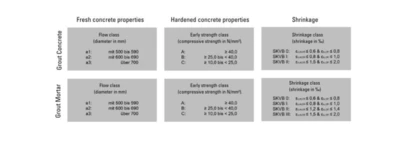
Both grout products are subject to early strength classes A, B and C.
Maximum layer thickness
The maximum layer thickness of the grout products corresponds to 25 times the maximum aggregate size for strength classes A and B. With the second revision of the guideline in 2019, this limit was increased to 40 times the aggregate size for strength class C.
Flow characteristics
The specific flow properties are categorised into flow spread classes for grout concrete and flow diameter classes for grout mortar. For grout mortars, the flow diameter is measured using a standardised flow channel and assigned to classes f1, f2, and f3.
For grout concrete, a slump cone is placed on a flow table and filled with three litres of grout concrete. The resulting spread is then classified into a1, a2, and a3.
 Measurement of the flow rate for grouting mortar using a flow channel.
 Measurement of the flowability of grouting concrete using a slump cone.
Shrinkage
In addition to early strength and flowability, the requirements for shrinkage classes are particularly important in distinguishing between grout concrete and grout mortar. Shrinkage is measured as the reduction in volume after 91 days using three specimens. The mean value (εs,m,91) and the individual value (εs,i,91) are used to determine the shrinkage class. There are three shrinkage classes (SKVB) for grout concretes and four shrinkage classes (SKVM) for grout mortars.
Expansion
Grout concrete and grout mortar also exhibit expansive properties. According to the DAfStb guideline, the expansion volume after 24 hours must exceed 0.1%.
Not covered by the guideline
In numerous applications, conventional steel reinforcement can be completely or partially substituted by the use of structurally effective fibres (according to EN 14889-1/-2). This eliminates time-consuming work steps such as cutting, bending and inserting the reinforcement. It also shortens the concrete manufacturing process As a result, construction times – including cycle times in precast production – can be significantly reduced, leading to lower overall costs and reduced personnel requirements.
Emcekrete: high-performance grout concretes and grout mortars
With its Emcekrete product systems, MC offers high-performance grout concretes and mortars for force-fit and void-free grouting in building construction, civil engineering, and road construction. Whether machine foundations or steel components - Emcekrete stands for permanently stable connections based on more than 60 years of experience and continuous development.
Interested? Read more here ...