 Germany
 Austria
 Belarus
 Belgium
 Bosnia and Herzegovina
 Bulgaria
 Croatia
 Czech Republik
 Denmark
 Finland
 France
 Georgia
 Great Britain
 Hungary
 Ireland
 Latvia
 Lithuania
 Netherlands
 Poland
 Portugal
 Romania
 Serbia
 Slovakia
 Spain
Spain
 Sweden
 Switzerland
 Ukraine
 Ethiopia
 Ghana
Ghana
 Egypt
Egypt
 Guinea
 Israel
 India
India
 Kazakhstan
 Malaysia
 Singapore
 United Arab Emirates
 Vietnam
 Taiwan
 Philippines
 New Zealand
 Australia
 Canada
 Brazil
 Paraguay
 Uruguay
 Bolivia
 Chile
Chile
 Peru
Peru


What are hydrophobic agents used for, and how do they work?
What are hydrophobic agents used for, and how do they work?
Hydrophobization, also known as hydrophobic impregnation, is a non-film-forming surface protection system for mineral surfaces with a water-repellent effect. Hydrophobization can be applied to most inorganic building materials such as concrete, mortar, natural stone, brick, and clay products.
Concrete is only considered to be permanently designed if its composition meets the requirements of the limit values defined in DIN EN 206. The prerequisite for this is that
- in the assessment
- the appropriate exposure classes have been selected for the design and
- the concrete cover complies with the required minimum value in accordance with the relevant design standard, e.g. DIN EN 1992-1-1, Eurocode 2 “Design of structures in concrete and prestressed concrete.”
- during processing
- the concrete is placed and compacted properly, e.g., in accordance with DIN EN 13670 “Execution of concrete structures.”
- the concrete is cured in accordance with DIN EN 13670, Section 8.5.
- during use
- the concrete is subjected to appropriate maintenance throughout its service life.
If these conditions are met during production and processing, it is necessary to ensure maintenance throughout the entire service life during further use. The first step is to identify known damage mechanisms and the second step is to initiate preventive measures.
The three principles of hydrophobization
In addition to impregnations and coatings, hydrophobization is another surface protection measure that is regulated in the European standard DIN EN 1504-2 “Products and systems for the protection and repair of concrete structures.” The test methods defined there differ depending on the protective measure (hydrophobization, impregnation or coating).
The following three principles are covered by hydrophobization:
- Principle 1 (PI: Protection against Ingress): Protection against the ingress of substances
- Principle 2 (MC: Moisture Control): Regulation of moisture balance
- Principle 8 (IR: Increasing Resistivity): Increasing electrical resistance by limiting moisture content
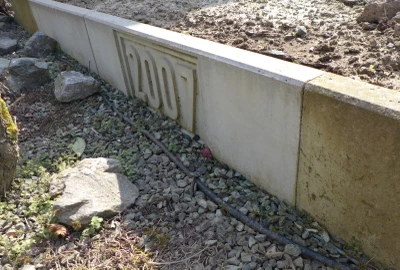
An example of the durability of concrete with a hydrophobic vs. non-hydrophobic concrete surface
All three principles show that hydrophobic treatments serve exclusively to reduce water absorption. Further applications or protective measures are neither intended nor technically feasible with these substances. For principle 5 (physical resistance/surface improvement) and principle 6 (resistance to chemicals), impregnations or coatings must therefore be used.
Current research results show that many causes of damage are directly related to the capillary water absorption of the concrete structure. The more open-pored and absorbent a concrete is, the higher its water absorption. This causes a variety of potentially damaging chemical-physical processes (e.g., dissolution, conversion, and crystallization processes) or visually disturbing processes (e.g., dirt deposits, water stains, and moss growth). These risks can be minimized by reducing both capillary water absorption and the transport of harmful media into the concrete. Since water acts as a transport medium, reduced water absorption also reduces the entry of pollutants. In order to reduce the water absorption capacity of concrete, it is necessary to build up a protective layer. Technical solutions such as hydrophobization have become established for this purpose. These are chemically bonded in the concrete cross-section, i.e., they are non-separable and do not form a film, and they do not alter the surface and its appearance to any significant extent.
Conclusion and outlook
In summary, it can be said that hydrophobic treatments are a technically proven and normatively validated method of significantly increasing the durability of concrete structures by reducing water absorption. They do not work by creating a physical barrier, but by chemically modifying the capillary walls, which effectively reduces the transport of damaging media.
The use of water repellents is particularly economical, as it reduces maintenance costs, prevents visual impairments, and extends the service life of structures. Nevertheless, it should be noted that their effectiveness must always be considered in the context of the correct choice of concrete, standard-compliant construction, and continuous maintenance.
Want to find out more?
In the second part of our MC pedia series, we take a closer look at the chemical and physical mechanisms of action of water repellents. We explain which groups of active ingredients are used, how they work in concrete and how their performance differs.