 Germany
 Austria
 Belarus
 Belgium
 Bosnia and Herzegovina
 Bulgaria
 Croatia
 Czech Republik
 Denmark
 Finland
 France
 Georgia
 Great Britain
 Hungary
 Ireland
 Latvia
 Lithuania
 Netherlands
 Poland
 Portugal
 Romania
 Serbia
 Slovakia
 Spain
Spain
 Sweden
 Switzerland
 Ukraine
 Ethiopia
 Ghana
Ghana
 Egypt
Egypt
 Guinea
 Israel
 India
India
 Kazakhstan
 Malaysia
 Singapore
 United Arab Emirates
 Vietnam
 Taiwan
 Philippines
 New Zealand
 Australia
 Canada
 Brazil
 Paraguay
 Uruguay
 Bolivia
 Chile
Chile
 Peru
Peru


Industrial floor for a food producer
Industrial floor for a food producer
Industrial floor for KADI AG
Langenthal - Switzerland
-
Name
Industrial floor for KADI AG
-
Country
Langenthal - Switzerland
-
Categories
Floors in the food industry are often exposed to heavy wear and tear, whether in the form of mechanical stress, aggressive chemical attack or hefty temperature fluctuations. And when all three factors come together, as in the case of KADI, a special solution is the only option. KADI’s oven roasting operation requires sunflower oil to be heated to almost 200 °C. In addition to the purely mechanical and thermal stresses affecting the floor, the acid content of the plant-based oil results in a high degree of aggressiveness. This is due to the harmful process of saponification that occurs in cement-bound building materials. With its relatively low viscosity, heated oil also penetrates particularly easily into the porous cement stone matrix.
Hybrid screed resistant to heat and aggressive acid attack
The company opted for a system structure with MC-DUR 2500, the polyurethane-cement hybrid screed from MC that is resistant to both heat and aggressive chemical attack. This had already proven successful on a trial area at the company’s premises in 2012 and is frequently used in the food and chemical industries. The industrial floor system provided by MC was supplied in an exclusive yellow shade especially developed for KADI AG. It was laid from April to May 2017 on an area of 1,000 m² by the specialist applicator Witschi AG, also from Langenthal.
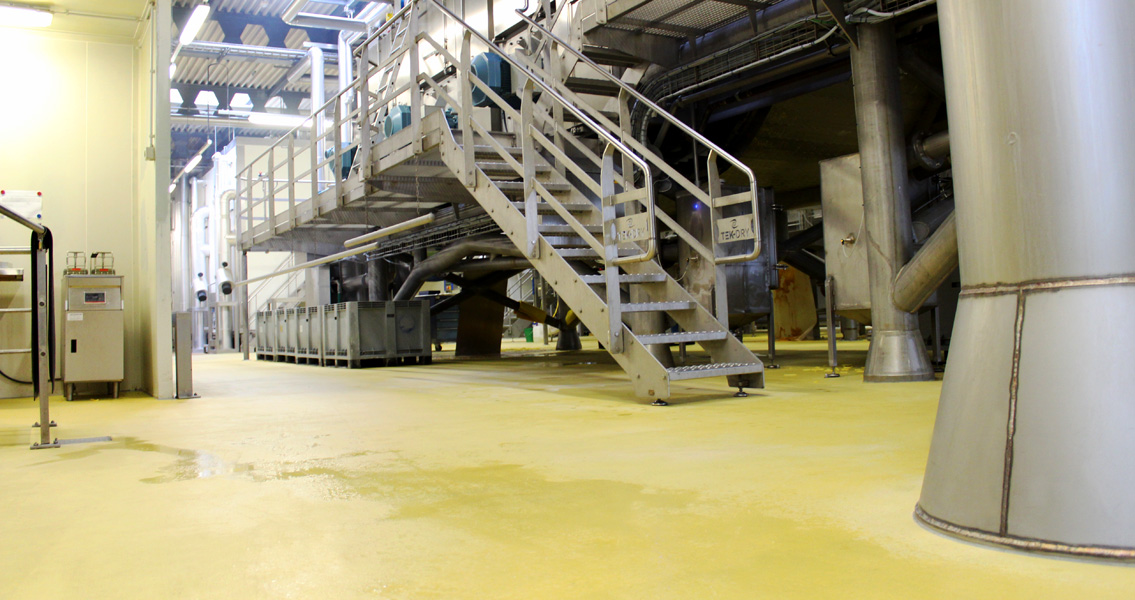
At the request of KADI AG, the industrial floor system of MC was supplied exclusively in a special yellow colour. It was quickly installed over an area of 1,000 m².
© MC-Bauchemie 2026
Fast repair with MC-Floor Screed
In order to adhere to the tight schedule and prevent any delay to the start date for oven installation, KADI opted for MC-Floor Screed 25, which is particularly suitable for heavy-use industrial floors. It hardens quickly and remains shrinkage-free, with the floor becoming accessible to foot traffic after about four hours. The screed can be overcoated after two days, achieving a compressive strength of 35 N/mm² after three days and 70 N/mm² after 28 days.
Once this challenge had been met, all the subsequent phases of the installation work ran like Swiss clockwork. A central cog was the on-site support provided by MC, including professional instruction from its Application Engineering people. MC-DUR 2500 was applied to the repaired substrate and sprinkled with quartz sand to achieve the required slip resistance. The top sealing coat took the form of MC-DUR 2500 VE. The result: A food-safe, particularly heat-resistant industrial floor with high impact resilience and high chemical resistance. These properties make it immune even to hot high-pressure jet cleaning with chemical additives, thus enabling full compliance with the high hygiene standards specified.
Check out this video of the application
https://www.youtube.com/watch?v=eKmXmogiBiM
RELATED CONTENT
More References