 Germany
 Austria
 Belarus
 Belgium
 Bosnia and Herzegovina
 Bulgaria
 Croatia
 Czech Republik
 Denmark
 Finland
 France
 Georgia
 Great Britain
 Hungary
 Ireland
 Latvia
 Lithuania
 Netherlands
 Poland
 Portugal
 Romania
 Serbia
 Slovakia
 Spain
Spain
 Sweden
 Switzerland
 Ukraine
 Ethiopia
 Ghana
Ghana
 Egypt
Egypt
 Guinea
 Israel
 India
India
 Kazakhstan
 Malaysia
 Singapore
 United Arab Emirates
 Vietnam
 Taiwan
 Philippines
 New Zealand
 Australia
 Canada
 Brazil
 Paraguay
 Uruguay
 Bolivia
 Chile
Chile
 Peru
Peru


Radiation protection
Radiation protection
Radiation protection concrete for Klinikum Darmstadt
Darmstadt - Germany
Built in 2016, the new central building of Darmstadt’s “Klinikum” hospital contains two rooms for the radiology department. To protect the surrounding areas, the walls and ceilings had to be built with heavy concrete, a challenging construction that was resolved thanks in part to admixtures from MC.
-
Name
Radiation protection concrete for Klinikum Darmstadt
-
Country
Darmstadt - Germany
-
Fields of Expertise
-
Categories
When contractor Leonhard Weiss from Satteldorf was awarded the contract for a new building at Darmstadt Klinikum, the requirements of the newradiology rooms were a major aspect of the project specifications. This construction phase not only required 8,000 m³ of standard concrete but also – among other things – 300 m³ of heavy concrete with a specified density of 4.2 t/m³ (standard concrete usually has a weight of 2.3 t/m³). The walls had to be 1.70 m and the ceilings 1.80 m thick. Lead plates with a total weight of 25 metric tons also had to be embedded in the ceilings – so all in all a taxing task for both the construction company and the ready-mix concrete manufacturer.
The heavy concrete challenge
Heavy concrete is made by adding dense aggregates such as magnetite, haematite or barite. Their ironcontaining components give the concrete a red colour. Because heavy concrete mixtures are very seldom used in Germany, the production facilities and machines are rarely designed for the enormous weights involved. Moreover, the concrete flow rate is significantly slower.
Consequently, it was necessary to reinforce all relevant technical facilities in advance and to develop an appropriate concrete formulation that guaranteed both uniform quality and a sufficiently wide application window. It also had to allow for the difficult transport conditions prevailing in Germany’s Rhine-Main region around Frankfurt. Thus there were major technical and logistical challenges for the ready-mix concrete provider to tackle.
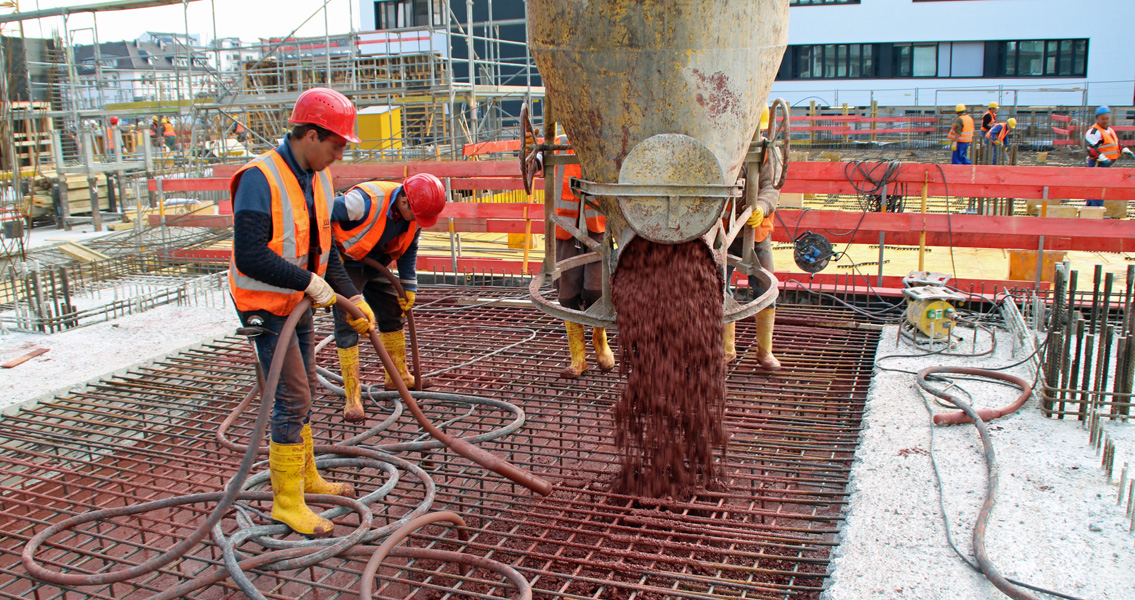
Heavy concrete: Profi-Beton and MC collaborated with great success in solving difficult technical and logistical challenges.
© MC-Bauchemie 2017
Optimum formulation
Given the radiation protection requirements and the technical capabilities needed in this regard, at the beginning of 2016 the highly qualified MHI Group with its subsidiary Profi-Beton was awarded the order of supplying the concrete for the construction project. Numerous preliminary trials were carried out in developing the formulation at MHI Naturstein & Baustoffservice GmbH, the group-internal test and surveillance unit serving Profi-Beton, in collaboration with all the project partners involved. As well as the other critical quality requirements, particular attention was given to adhering to the specified time window, even at high ambient temperatures, as construction was to take place in high summer. With MC-PowerFlow 5100, a superplasticiser based on MC’s latest polycarboxylate ether technology, an optimum flow facilitator with no segregation problem was found that offered cost-efficient dosage quantities. As a result of further formulation optimisations in relation to the haematite and FE-aggregate granulates, a density of 4.4 t/m³ was ultimately achieved, thus significantly exceeding the requirements specified in the radiation protection regulations. Thus, an optimum formulation was developed that met the technical and logistical requirements of the job and has consistently proven to have been an excellent choice eve since the first concrete batches were laid in May 2016.